De Montfort University Kazakhstan · Almaty

Keep your Job& Earn yourBritish MBA

A Global MBA built for people already building a career — taught in blocks on Saturdays, over two years, without asking you to step away from work.

TEF 2023
NUE Awards
Times Higher Education
QS Top Universities
2 years

Part-time route
to a UK degree

British MBA

Awarded by DMU Leicester

Block teaching

One subject at
a time

Saturdays

Classes fit around your working week

Why this MBA

Career development, not a career break

"Balance your job, business, or family commitments — you won't need to take a career break to pursue your MBA."

Our Global MBA focuses on career development and skill enhancement, strengthening your analytical and numerical thinking to evaluate situations, identify and solve problems confidently.

The programme provides an advanced, practical understanding of international business, helping you adapt to global business and management challenges, while recognising and articulating your skills, abilities and achievements to advance your career.

The room you'll be in

Learn alongside people who bring business to the classroom

You'll study alongside founders, managers and specialists who bring experience from their own organisations. In each module, you'll explore business ideas together and consider how they apply to decisions you face at work.

As you move through the programme with the same cohort, you'll get to know one another's perspectives and build a network that lasts beyond the classroom.

PACE certificates, masterclasses, alumni events, corporate visits, and guest lectures offer further opportunities to develop practical skills, hear from business leaders and connect with the wider professional community.

One subjectAt a time, in block
Peer networkAcross sectors in Kazakhstan
Guest lecturesFrom industry partners
Key features

Built around a working professional's week

8

Reasons the Global MBA is designed to fit around the career you're already building, not compete with it.

Study without a career break

Earn a British MBA while staying in Almaty — balance your job, business or family commitments throughout.

Practitioner-academics

Learn from academically experienced staff who also carry real industry backgrounds — theory tested against practice.

Industry partnerships

Guest lectures, industry events and local and international perspectives, built on strong sector partnerships across Kazakhstan.

NEXUS access

Our experiential learning platform offers free events, business surgeries and networking sessions for entrepreneurial students.

Global trips

Visit key business and technology hubs abroad to broaden your perspective beyond the Almaty classroom.

Block teaching

One subject at a time, with regular feedback and assessment — a timetable that builds engagement and camaraderie.

DMU Leicester library

Full access to the DMU Leicester library and additional learning resources for research and study.

Saturdays, two years

Delivered on Saturdays over two academic years — a manageable work-life balance from day one.

100%

of our academic staff have international experience

Ferdinand Che

Head of Business Management & Law. Supply chain and data intelligence

Mehdi Aqarabi

Program Leader. Marketing & strategy

Alvin Karkun

Leadership and Business Sustainability

Anass Karzazi

Cross-Cultural Management and Marketing

Néfissa Salma

Entrepreneurship

Ulyana Popova

Marketing & strategy

Mani Pouyan

Business Finance and Enterprise Development

Muhammad Owais Qarni

Business Finance and Enterprise Development

01 / 04
Structure & assessment

Six blocks, one subject at a time

You study the core modules of the DMU Leicester Global MBA in sequence — each block gets your full attention before the next begins. Swipe through the blocks and tap Read more for details.

A

Leadership and Business Sustainability

How can leaders deliver strong organisational performance while responding responsibly to social, environmental and ethical challenges?

This module explores leadership, motivation, employee engagement, talent development and organisational culture within a rapidly changing business environment. You will consider how leadership practices must adapt across organisations and cultures and develop a critically informed approach to managing people.

Sustainability is examined as a practical management responsibility. You will explore how businesses contribute to the global Sustainable Development Goals and how sustainability commitments can be governed, implemented, measured and reported. The module also considers the challenge of balancing short-term financial priorities with longer-term organisational and societal needs.

Contemporary cases, research and discussion will help you connect academic ideas with management practice. By the end of the module, you will be better equipped to evaluate organisational impact, question established assumptions and propose responsible solutions to complex leadership and sustainability challenges.

B

Advanced Strategic Management

A successful strategy must do more than look convincing on paper. It must respond to change, guide difficult decisions, and translate into practical action.

This module develops your ability to analyse complex strategic challenges and turn organisational priorities into workable projects.

You will examine major schools of strategic thought, as well as corporate, business-level, growth, and internationalisation strategies. Rather than applying standard frameworks mechanically, you will evaluate their assumptions, limitations and suitability for different organisational contexts.

The module also connects strategy with project management. You will explore the project life cycle, project teams and the tools used to plan, implement and evaluate organisational change. You will consider how human factors, uncertainty and organisational failure affect strategic outcomes.

By combining strategic analysis, research evidence, and project planning, the module prepares you to evaluate alternatives, make informed decisions, and develop realistic recommendations that reflect organisational priorities, available resources, and wider sustainability considerations.

C

Cross-Cultural Management and Marketing

Management practices and marketing strategies do not transfer automatically from one country to another.

Culture influences communication, negotiation, workplace relationships, conflict and customer expectations. This module prepares you to make informed decisions within international and culturally diverse environments.

You will critically examine established cultural frameworks, including the work of Hofstede, Minkov and Trompenaars. Rather than using these frameworks to stereotype national cultures, you will evaluate how they can support a more nuanced understanding of intercultural situations.

The module applies this knowledge to international marketing. You will explore how marketing strategies should be adapted for different countries, how cultural conditions influence customer responses and how market-entry barriers can affect international expansion.

You will also consider opportunities created by electronic media and communication technologies. Through scenarios, business cases, and collaborative activities, you will develop the ability to analyse intercultural challenges, formulate international marketing strategies, and communicate culturally sensitive solutions to colleagues, customers, and business partners.

D

Business Finance

Managers do not need to be accountants, but they must understand what financial information means and how it should influence decisions.

This module develops the financial knowledge and analytical confidence required to assess performance, evaluate opportunities and support business growth.

You will learn to interpret key financial statements and use financial ratios to examine organisational performance. The module also covers the time value of money, risk and return, capital structure, investment fundamentals, and the role of financial markets and institutions.

A strong enterprise focus connects these concepts with the realities of creating and growing a business. You will examine small-business finance, funding strategies, fundraising, expansion and scale-up decisions. Hands-on activities will help you calculate, interpret and present financial evidence.

By the end of the module, you will be better prepared to participate in financial discussions, compare business and funding models, and justify recommendations to managers, investors and other stakeholders.

E & F

Research Methods: Entrepreneurship Project, or Consulting Project

Two routes to complete your MBA: build your own venture proposal, or solve a real business brief as a consultant.

Research Methods & Entrepreneurship Project

Turn a business idea into a researched, financially informed and professionally presented venture proposal. You will identify an opportunity and a clear value proposition, use primary and secondary market research to test demand, then develop a marketing strategy, operational plan and financial budgets.

A specialist supervisor guides you, but you set the objectives and drive the venture, concluding with a comprehensive business plan and a live, investment-style pitch.

Research Methods & Consulting Project (simulator)

Act as a consultant to a virtual organisation and test your recommendations inside a simulated business environment. You will investigate a complex brief involving a process, structure, product, service or business model, analyse the evidence, then recommend and implement a course of action.

The simulation lets you see how the organisation responds, so both successful and unsuccessful decisions become learning, strengthening your ability to diagnose problems, interpret evidence, work independently and decide under uncertainty.

01 / 03

Complimentary PACE Certificates

While we offer the core Global MBA modules from DMU Leicester, we have enhanced your experience with a selection from our continuing professional development (CPD) Certificate modules, made available to MBA students at the end of each block to boost in-demand capabilities. These additional modules are tailored to our local expertise and the profiles and expectations of our students.

+ Data-Driven Decision Making & AI for Managers

Turn business data into confident decisions using Excel, Power BI or Tableau, sound statistical reasoning, critical evaluation of AI-generated insights, and persuasive, data-informed business cases and operational recommendations.

+ Operations, Value Chains & Digital Transformation

Map processes, analyse value chains, weigh supply-chain trade-offs in resilience, sustainability and cost, and identify digital-transformation opportunities through automation, ERP and AI.

+ Behavioural Economics, Negotiation & Decision Frameworks

Make smarter, more ethical decisions by recognising cognitive biases, applying behavioural insights to pricing, marketing and people choices, and negotiating from interests rather than positions.

+ Personal Leadership, Executive Presence & Career Capital

Build a distinctive leadership philosophy and value proposition, assess your career with purpose, create a focused development plan, communicate with executive presence, and build a strategic network.

+ Managerial Economics and Accounting

Apply economic reasoning to demand, pricing, competition and resource allocation, using cost, budgeting, break-even and performance information to evaluate choices and improve organisational results.

Taught alongside the core Global MBA modules

Teaching & assessment

Assessed the way working adults actually study

To keep your work-life balance manageable, the Global MBA is delivered on Saturdays over two academic years.

Formative in-class feedback is central to how the programme works — it engages you in reflecting on how you approach and evaluate your own learning against each module's outcomes.

Assessment runs through portfolios

  1. 01You begin tasks early in the module
  2. 02get formative feedback along the way
  3. 03and submit everything together at the end.
*That variability supports incremental skills development and reflects UDL principles throughout the programme.
Do you qualify

Entry criteria & English requirements

Entry criteria

An undergraduate degree in any subject, with a minimum pass of 2:2, or an equivalent overseas qualification.

Or a minimum of five years' managerial work experience or equivalent — a professional qualification of equivalent standing is considered individually.

English language

If English isn't your first language, you'll need a minimum IELTS score of 6.0 overall, with at least 5.5 in each band (or an equivalent score) to start the course.

Below that? Our English Language Centre (CELL) runs general English and IELTS preparation courses to get you ready to begin.

Key features

The degree, awarded
from the UK

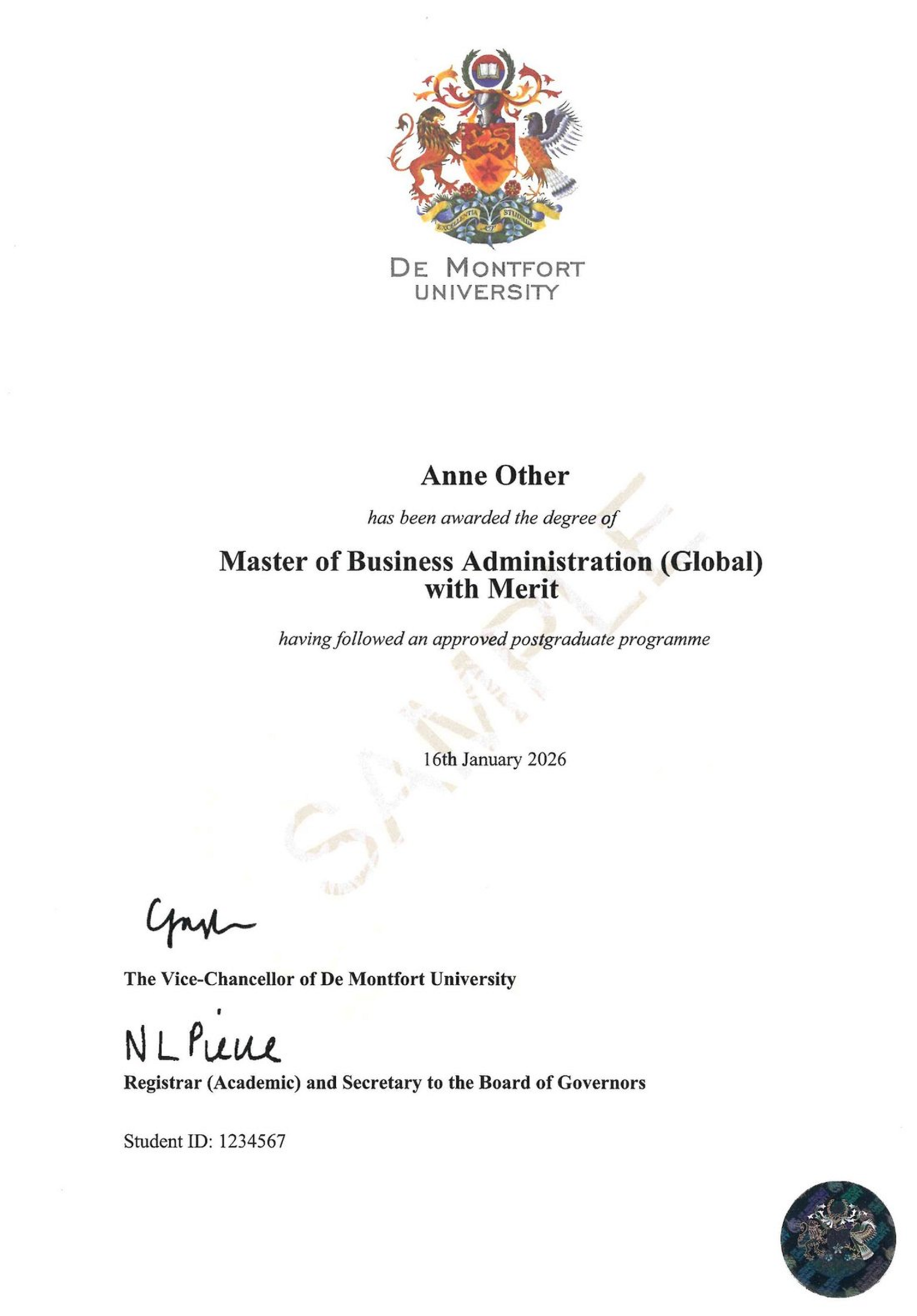
Your Global MBA is awarded by De Montfort University in Leicester, England — the same British degree, the same academic standards, delivered to you in Almaty. The certificate below is a sample, shown to illustrate exactly what that looks like.

Sample DMU Global MBA certificate
Scholarships

Funding built for where you are in your career

Financial limitations shouldn't stand between you and a world-class education. DMU Kazakhstan offers income-based and merit-based partial scholarships — contact admissions for full detail on any of these.

UP TO 40%

Future Leaders Scholarship

For emerging business leaders with at least five years of full-time work experience — the University looks for exceptional leadership qualities and a clear, visionary outlook.


  • IELTS 6.0, 5+ years' professional experience
  • Evidence of leadership achievement (professional, sports, charity or fundraising)
  • Admission-committee interview required
UP TO 40%

Women Entrepreneurs Scholarship

Supports the economic empowerment of women, for both aspiring and experienced female entrepreneurs.


  • IELTS 6.0
  • Female applicants with a documented history in enterprise development
  • Able to present their business concept
  • Mission and milestones. Interview required.
UP TO 40%

Emerging Graduate Scholarship

For high-potential recent graduates with limited or no full-time professional experience, but strong academic performance and leadership potential.


  • IELTS 6.0
  • Recently completed undergraduate degree
  • GPA of 3.0 or equivalent
  • Interview assesses motivation
  • Postgraduate readiness
UP TO 25%

DMUK Alumni Scholarship

For DMUK alumni committed to lifelong learning who apply to the Global MBA — a scholarship that rewards you for staying in the DMU family.


  • Alumni with First Class or Upper Second Class
  • Honours are eligible for up to 40% instead of 25%
DMU Kazakhstan campus
Campus tour
Watch the campus tour
avenue. Al-Farabi, 120/65

Modern
Campus

Well-developed infrastructure in a prestigious area of Almaty

This is where it ends up

DMU Kazakhstan Global MBA graduates, together on graduation day — the same cohort that sat next to you every Saturday.

Your MBA starts with one conversation

Talk to the DMU Kazakhstan admissions team about entry routes, scholarships, and how the Saturday timetable fits around your work.